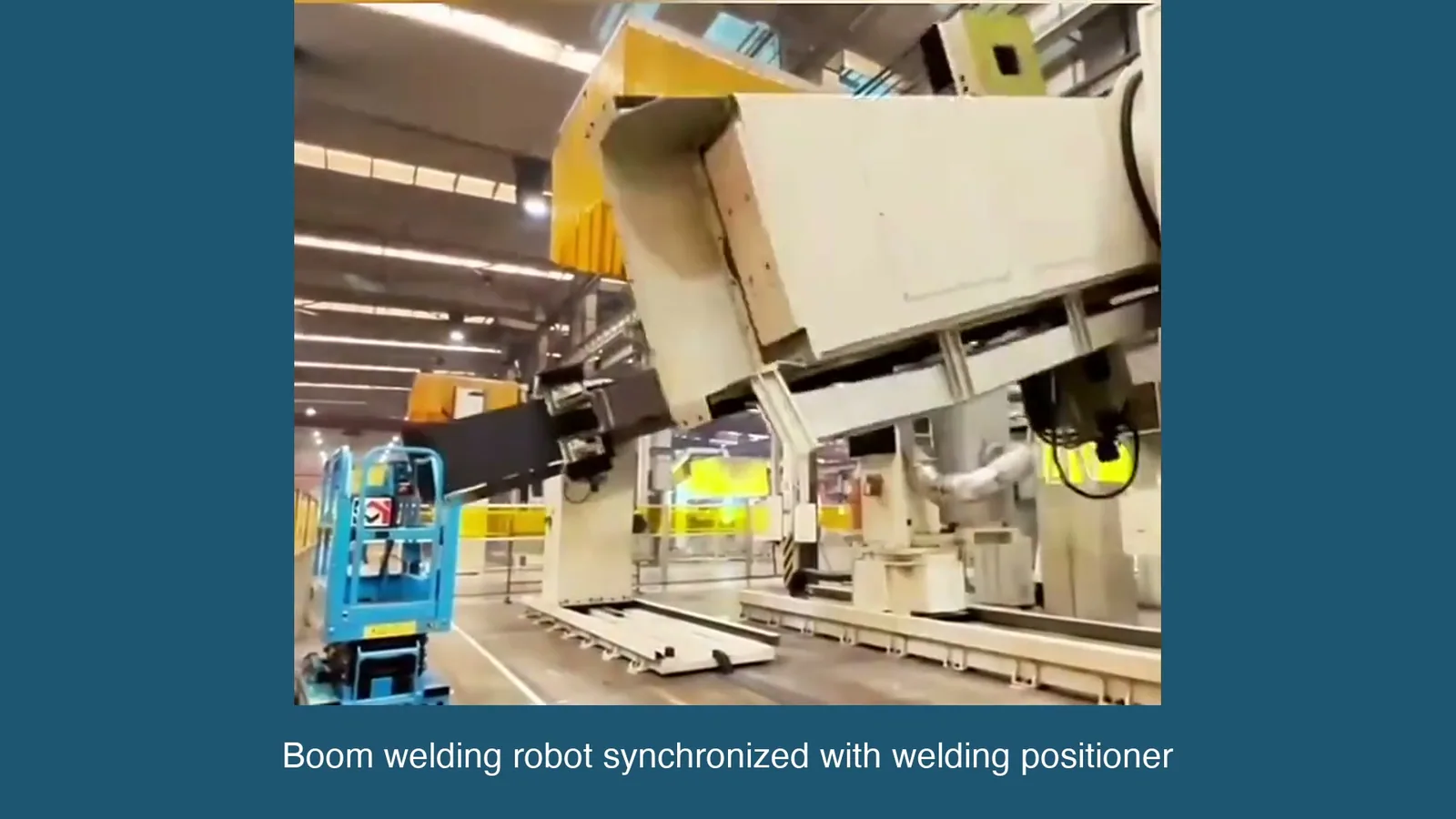
A column-and-boom manipulator is a reach machine, not a crane. Buy it for torch placement, not for lifting. The common mistake is sizing the boom by the farthest weld on the biggest part and then wondering why the arc wanders 8 mm on a 3.5 m extension. Reach and stiffness fight each other. A 4 m boom that looks fine on a layout drawing can sag 12 mm under a 200 kg torch head, and that sag changes as the carriage travels. You cannot fix that with the wire feeder.
Reach is not free: why a longer boom sags
Boom deflection rises roughly with the cube of extension. Double the reach and you get about eight times the deflection for the same section and load. A 200 kg head at 2.0 m might deflect 1.5 mm. At 4.0 m, the same boom can deflect 12 mm. At 5.0 m, 24 mm is realistic. That is not a cosmetic issue. A 12 mm vertical drop changes contact-tip-to-work distance, and with a 1.2 mm wire at 500 A and 28 V, a 6 mm change in stick-out will move the arc and change penetration.
Column stiffness matters as much as boom section. A 6 m column with a 2 t head capacity can twist 0.2 degrees under an offset load. At 4 m reach, 0.2 degrees is 14 mm of arc wander. Check the torque rating, not just the vertical capacity. The bearing stack and the column-to-base connection decide whether the arc stays put when the boom rotates.
| Boom extension | Typical deflection at 200 kg head | Practical effect on arc position |
|---|---|---|
| 2.0 m | 1.5 mm | Acceptable for most 1.2 mm wire work |
| 3.0 m | 5 mm | Adjustable with AVC, but watch travel repeatability |
| 4.0 m | 12 mm | Weld wander likely on 12 mm plate at 350 mm/min |
| 5.0 m | 24 mm | Do not buy this combination for precision work |
Travel and rotation duties: size the motions, not the catalog
List the motions separately: carriage travel along the rail, boom lift, column rotation, and cross-slide. A 6 m rail with 2.4 m/min rapid travel is fine for positioning, but welding travel may be 250 mm/min. If the drive is geared for rapid only, low-speed smoothness suffers and you get stick-slip at 0.5 m/min.
Ask for a 10:1 turndown on the travel drive and a tested minimum speed. Column rotation at 0.1 degree resolution sounds precise until you load the boom at 3.5 m and see 3 mm of backlash at the torch.
Duty cycle is where buyers get quiet. A manipulator rated 500 A at 60% duty is not a 500 A at 100% machine. If your cell runs two shifts at 85% arc-on time, derate the current or buy the next frame. The cost difference between a 400 A and 500 A package might be $18,000, but the rework from a cooked torch head and a wandering arc will eat that in a month.
Welding manipulator duty is not positioner duty
A welding manipulator carries the torch. A positioner carries the work. Do not compare their load ratings. A 2 t positioner may need 10 kNm of torque to rotate an offset weldment; a 2 t manipulator head capacity refers to tooling and torch load at the end of the boom.
If you put a 1.5 t workpiece on a manipulator table, you are using the wrong machine. The positioner must hold the part at 0.5 degree indexing and 2.5 r/min for circumferential welds; the manipulator just needs to put the torch there and keep it there.
This distinction drives the purchase. If 70% of your work is 300 mm diameter pipe spools under 400 kg, a 1.5 m boom and a 1 t positioner will outperform a 4 m manipulator. If your work is 8 m long box girders with welds on both sides, you need a 6 m rail, a 4 m boom, and a travel carriage with 1.2 m/min welding speed. The manipulator is not the positioner, and the positioner is not a fixture.
Installation mistakes that show up as weld wander
- Rail out of level by 3 mm over 6 m. The torch rises and falls with the carriage, and the arc length changes without any AVC command.
- Floor slab deflection under the column. A 10 mm slab dip at the base becomes 15 mm at 4 m reach. Bolt the base to a separate foundation, not to a 150 mm slab.
- Cable track pull. A tight torch cable pulling 20 kg sideways at full extension adds to boom deflection and shows as a one-direction wander.
- Bearing preload set by feel. Column rotation backlash of 0.3 degrees at 3 m reach is 16 mm at the arc. Use a dial indicator, not a pry bar.
- Thermal growth. A 6 m column in a shop that swings from 12 C to 32 C grows about 1.5 mm. That is small until you stack it with rail misalignment and boom sag.
Weld wander is usually a stack-up, not one failure. Check the foundation first, then rail level, then boom deflection under the actual torch head, then cable pull. A 0.2 mm repeatability claim on a manipulator means nothing if the rail is shimmed with 15 mm plates and the anchor bolts are hand-tight.
Cases where the answer is dont buy
Do not buy a column-and-boom if your largest weld is 1.2 m from the floor and your parts are under 300 kg. A fixed bench and a 1 t positioner will do the job for less money and less floor space. Do not buy a 5 m boom for 500 A spray transfer with a 200 kg head; the deflection will fight your AVC all day.
Do not buy a manipulator to fix a fit-up problem. If the joint gap varies 4 mm, the torch will follow the gap, not the print. And do not buy a used unit with a 6 m rail unless you can measure the rail straightness and the column twist before it leaves the floor.
Size the machine to the 80th percentile of your work, not the one-off 9 m job. Rent or subcontract that job. Put the money into stiffness, rail foundation, and a travel drive that holds 250 mm/min without stick-slip. For the full list of capacity, duty, and accuracy data to compare against your weld procedure, see our welding equipment technical specifications.
Welding Manipulator / Column & Boom (WM Series)
Technical Specifications:
| Model | Boom (m) | Vertical Stroke (m) | Horiz. Speed (m/min) | Max Load (kg) | Total Ht (m) | Weight (tons) |
|---|---|---|---|---|---|---|
| WM1515 | 1.5 | 1.5 | 0.12-1.2 | 100 | 2.9 | 1.0 |
| WM2020 | 2.0 | 2.0 | 0.12-1.2 | 100 | 3.4 | 1.5 |
| WM3030 | 3.0 | 3.0 | 0.12-1.2 | 200 | 5.5 | 4.6 |
| WM3040 | 3.0 | 4.0 | 0.12-1.2 | 200 | 5.5 | 5.1 |
| WM4040 | 4.0 | 4.0 | 0.12-1.2 | 200 | 6.5 | 5.5 |
| WM5050 | 5.0 | 5.0 | 0.12-1.2 | 300 | 7.8 | 6.5 |
| WM6060 | 6.0 | 6.0 | 0.12-1.2 | 300 | 9.7 | 7.5 |
| WM7060 | 7.0 | 6.0 | 0.12-1.2 | 300 | 10.7 | 8.5 |
| WM8060 | 8.0 | 6.0 | 0.12-1.2 | 300 | 11.7 | 10.0 |
| WM8010 | 8.0 | 10.0 | 0.12-1.2 | 300 | 11.7 | 12.0 |
Note: Cross-section rectangular beam, stress-relieved. Boom drooping 2mm/m. Column revolve (motorized/manual). Anti-fall safety device. CE mark available.
For detailed specifications and pricing, contact us at [email protected] or visit https://biqee.cn.
Conclusion
Choosing the right welding automation solution is key to improving productivity and quality in your fabrication operations.